

You notice it the moment you connect at an airport, hotel, campus, or cafe: the internet works, but your control doesn’t. Your traffic passes through networks you do not own, platforms track your activity, and some content still stays blocked by region or policy. That is where understanding vpn versus proxy differences stops being technical trivia and starts becoming a smart decision about privacy, speed, and freedom online.
A lot of people treat VPNs and proxies like interchangeable tools. They are not. Both can change how your connection appears to websites and services, but they solve different problems, offer different levels of protection, and come with very different trade-offs. If you want more than a quick workaround, the details matter.
VPN versus proxy differences at a glance
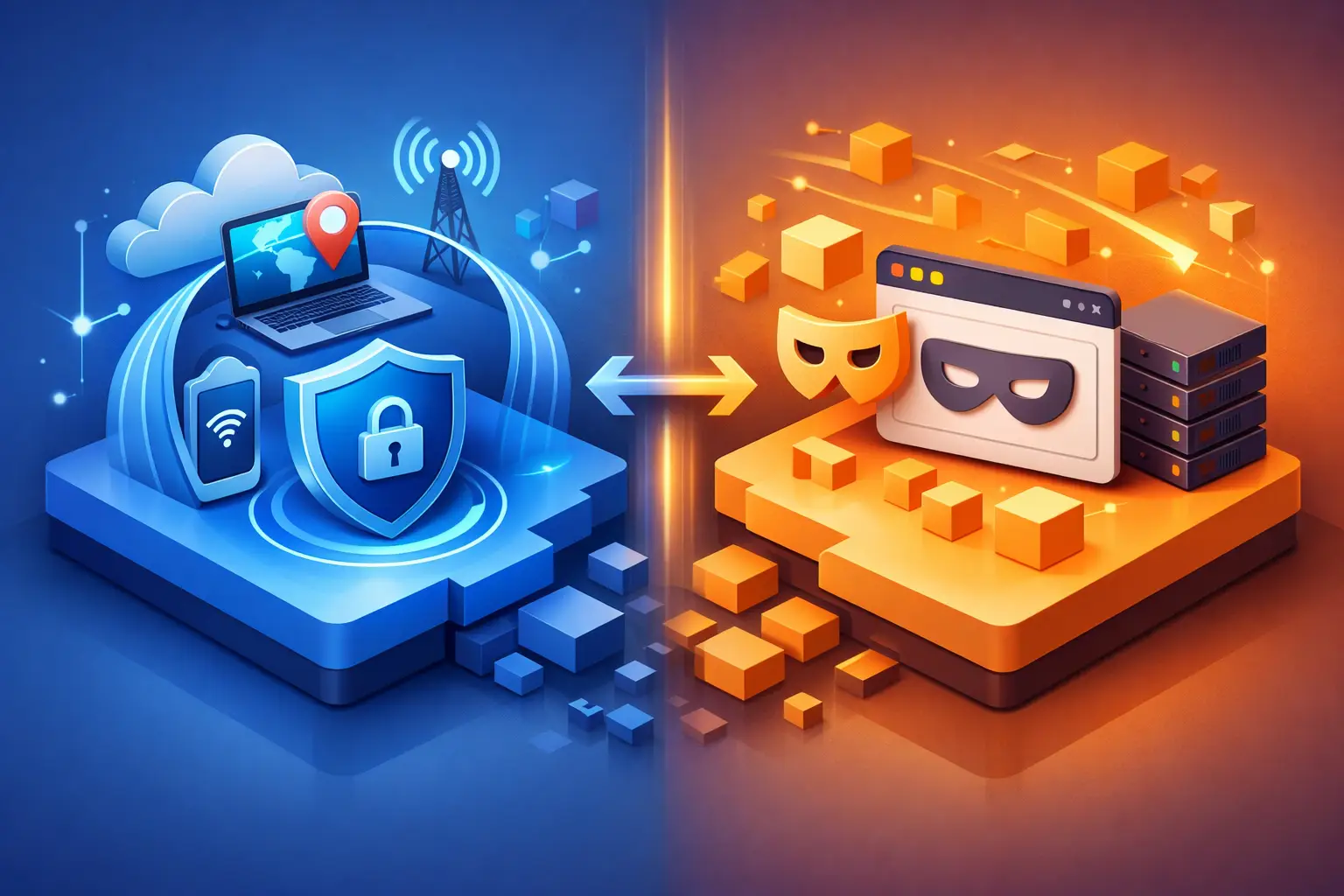
The simplest way to think about it is this: a proxy reroutes specific traffic, while a VPN protects your connection more broadly. A proxy server acts like a middleman between your app or browser and the site you are trying to reach. It can mask your IP address and make it look like you are connecting from somewhere else.
A VPN does that too, but it also encrypts your internet traffic between your device and the VPN server. That extra layer changes everything. It means people on the same network, your internet provider, and many forms of passive monitoring have a much harder time seeing what you are doing.
If your goal is basic location masking for one task, a proxy may be enough. If your goal is privacy, safer public Wi-Fi use, and more complete protection across apps and devices, a VPN is the stronger tool.
What a proxy actually does
A proxy is usually lighter, narrower, and more limited. In many cases, you configure it inside a browser or a specific app. Once it is active, requests from that app travel through the proxy server first, and the destination site sees the proxy server’s IP instead of yours.
That can help with simple use cases. You may want to access region-restricted content, test how a website appears in another country, or separate a certain browsing session from your usual IP address. For that, a proxy can be convenient.
The weakness is that most proxies do not encrypt your traffic end to end from the device in the way a VPN does. Some proxies only handle web traffic. Some only work in one app. Some expose metadata or leave traffic outside the proxy tunnel untouched. That means your privacy can still be thin, especially on public or untrusted networks.
There is also the quality problem. Many free proxies are slow, unstable, overloaded, or poorly managed. Some log your activity. Some inject ads. Some simply stop working when you need them most. A proxy can look fast on paper and still feel unreliable in real use.
What a VPN actually does
A VPN creates an encrypted tunnel between your device and the VPN server. That means your browsing, app traffic, and other online activity are shielded while they travel across the local network and your provider’s infrastructure. Websites still see the VPN server’s IP, but the bigger value is not just disguise. It is protection.
That matters most when you are working from shared networks, handling payments, logging into business platforms, attending class remotely, managing client files, or streaming on connections you do not fully trust. A VPN gives you a broader security perimeter without forcing you to reconfigure every app one by one.
It also tends to be a better fit for people who move between devices. If you need privacy on a phone, laptop, tablet, or even devices connected through a protected hotspot, a VPN offers a more complete setup. That is a major difference for travelers, freelancers, students, and small teams who do not want security to stop at a single screen.
The biggest vpn versus proxy differences that affect real users
Encryption is the headline difference because it changes your risk profile right away. With a VPN, your traffic is encrypted in transit. With a standard proxy, that often is not the case. If you are using hotel Wi-Fi, coworking space internet, or a campus network, that gap matters more than most people realize.
Coverage is next. A proxy often works at the application level. A VPN usually works at the device level, covering traffic across apps and services. If you only want to route browser traffic, a proxy may be enough. If you want broader protection without managing separate settings for each tool, a VPN is more practical.
Then there is authentication and trust. Serious VPN providers build their service around privacy, performance, and secure infrastructure. Proxy services vary wildly. Some are useful. Some are sketchy. When the service handling your traffic is not transparent, the low barrier to entry becomes a liability.
Performance is more nuanced. People often assume proxies are always faster because they do less, and sometimes that is true. Less encryption can mean less overhead. But raw speed is not the whole story. A well-run VPN network with optimized servers can outperform cheap or crowded proxies in real-world browsing, streaming, and file transfers. Speed depends on infrastructure, routing quality, server load, and distance, not just protocol type.
When a proxy makes sense
A proxy is not useless. It is just narrower than many people expect. If you are doing light, low-risk tasks like checking localized search results, testing geolocation behavior, or accessing a website through a single browser session, a proxy can be a practical shortcut.
It may also make sense when you are working in a controlled environment and you only need traffic from one tool routed through another IP. Developers, testers, and advanced users sometimes use proxies for this reason. They can be flexible for specific workflows.
But that is the key phrase: specific workflows. A proxy is usually a tactical tool, not a complete privacy solution.
When a VPN is the better choice
If you care about privacy on public Wi-Fi, a VPN wins. If you want encrypted traffic while traveling, a VPN wins. If you need more reliable protection across apps, devices, and daily online activity, a VPN wins again.
It is also the better option for people who do not want to constantly think about what is or is not protected. That peace of mind matters. When security depends on remembering which browser window or app uses a proxy, mistakes happen. A VPN simplifies the decision by protecting more of your activity automatically.
For remote professionals, students, and frequent travelers, that consistency is a huge advantage. Fast, secure, built-for-real-life connectivity beats piecing together partial workarounds every time you change networks.
Security trade-offs people overlook
The biggest mistake is assuming hidden IP means private activity. It does not. A proxy can hide your IP from a destination website while still leaving your traffic exposed elsewhere along the path. That is a very different security posture from a VPN.
Another overlooked issue is DNS leaks and traffic outside the configured app. If your proxy only covers one browser, what about background app traffic, file sync tools, video calls, or software updates? Those may still use your regular connection unless separately configured. With a VPN, coverage is typically broader and easier to control.
There is also the issue of trust in free tools. If a service costs nothing, you have to ask what the business model is. Logging, ad injection, data collection, and poor maintenance are common risks in the proxy space. The same caution applies to some VPNs, but quality VPN providers are generally built around long-term privacy and performance promises because that is the service users are paying for.
Which one should you choose?
Choose a proxy if your need is limited, temporary, and low-risk. You want a quick location switch for one app or browser session, and you understand the security limits.
Choose a VPN if you want real control over your connection. That means encrypted traffic, stronger privacy on public networks, more consistent access across devices, and fewer blind spots in day-to-day use. For most people balancing work, study, travel, streaming, and personal privacy, that is the smarter investment.
If you want both speed and protection, do not frame the decision as minimal effort versus maximum security. The better question is what level of exposure you are willing to accept. A proxy can be enough for a narrow task. A VPN is built for how people actually live online now – connected everywhere, switching devices constantly, and expecting security without friction.
That is why services like BexVPN are designed around more than simple IP masking. Users want freedom, yes, but they also want control that carries across devices, hotspots, and daily routines without technical hassle.
The best choice is the one that matches your real risk, not your shortest checklist. If your online life moves fast, your protection should move with it.





Leave a Comment